Articles by "Riga"
Rāda ziņas ar etiķeti Riga. Rādīt visas ziņas
Travel Guide with beautiful photos and exciting descriptions of the most amazing and unique places in Baltic states and Europe.
On the top floor of Radisson Blu hotel highrise in Riga there is a skyline bar - a place which offers probably the most beautiful panoramic view of Riga. The harmonious scenery includes centre boulevards and parks, Old Town and almost all the highrise accents in one, charming view. Especially beautiful it gets in blue hour when the lanterns are switched on, the streets turning yellow/orange, the trees remains green and the rooftops turns blueish. On the opposite direction the panorama leads your eye in voyage over the 19th/20th Century "belle epoque" age (Eclecticism, Art Nouveau and other  styles) buildings' rooftops, layouted in impressive perimetrical quarters. 

The downside of this location is that the view is seen through windows so reflections of interior can be very disturbing and annoying, especially if you're photographing and trying to get high quality pictures. Heavy and difficult post-processing will be required to at least minimize reflections.

Practical information. Technically the entrance is free, but as it is the restaurant/bar, it would be polite to order some drink. They're not cheap in this place but with just a coffee you could go with few euros. However there's another complication - the place is very popular and that means if you want to be sure you get to the table at the window to Old Town side, you must likely should make a reservation before. Btw, there is also an option to see the views to southern and northern sides of Riga from the staircase windows (and the view to Old Town is visible also from the toilett next to the Skybar but, well, it doesn't seem to be the most appropriate place to enjoy the scenery :)).  


Travel Guide with beautiful photos and exciting descriptions of the most amazing and unique places in Baltic states and Europe.
The Freedom Monument is perhaps the most important symbol of Latvia's independence in cityscape. It was built by people's donations in interwar period, 1935, and devoted to those who died in Latvian Independence War (1918-1920). The monument is 42 metres high and is made of of granite, travertine, and copper (Freedom statue at the top of monument has became green by oxidation). Freedom monument is nowadays used as a public gatherings place for official commemoration or celebration events.

Travel Guide with beautiful photos and exciting descriptions of the most amazing and unique places in Baltic states and Europe.
World-class contemporary architecture design in the first modern highrise in Riga. It was built on the opposite Daugava river bank to Old Town in 2004 and can be listed between the best modern landmarks in Europe alongside London's Gherkin, Malmo's Turning Torso, Barcelona's Agbar and others.


Travel Guide with beautiful photos and exciting descriptions of the most amazing and unique places in Baltic states and Europe.
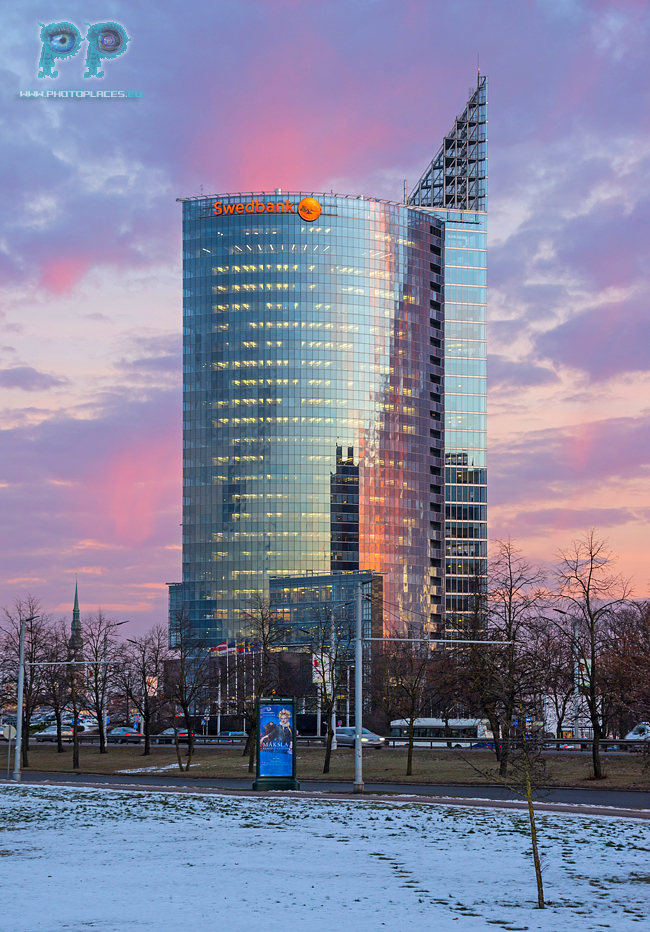
The newest landmark building in Riga was opened in 2014 after 25 years old project made by one of most internationally famous Latvian architects Gunars Birkerts. The building symbolizes "Glass mountain" which is motive in the work "Zelta zirgs" of Latvian poet Rainis.


Travel Guide with beautiful photos and exciting descriptions of the most amazing and unique places in Baltic states and Europe.
Another Neo-Baroque version of Historicism, National Theatre building was built as a theatre in 1902 and is still the theatre today. It has a special place in history of Latvia - exactly here independent Latvia state was founded in 1918.


Travel Guide with beautiful photos and exciting descriptions of the most amazing and unique places in Baltic states and Europe.
Detailed, intricate and beautiful Eclecticism/Neo-Gothic church with a 63 metres high tower in the streets junction of Riga 19/20th Century apartment quarters. The 19th Century-middle built church creates the strong visual impression of ascending to the sky, it even resembles a rocket ready to take off.
Travel Guide with beautiful photos and exciting descriptions of the most amazing and unique places in Baltic states and Europe.


St Peter's church is the highest vertical accent of Old Riga and one of the city's most recognizable landmarks. First mention of the St. Peter's Church is in records dating to 1209 and until nowadays it's side walls have been preserved from that time. Nowadays church tower is 123 metres high but interesting that back in 15th Century it was higher - 136 metres. The church suffered in fires both in 1st and 2nd World Wars, it was rebuilt in Soviet times and the current tower is from that time, just around 40 years old.
Travel Guide with beautiful photos and exciting descriptions of the most amazing and unique places in Baltic states and Europe.
This is by far the most popular vantage point in Riga. Many of the city's classic panorama views you find on the internet are taken from here. St Peter's church tower offers an observation platform at the height of 72 meters (it's accesible by an elevator, so you can spare your legs for more city exploration walks on the street level). 

St Peter's church is located in Old Town, right in the middle of the city, thus it provides centrally located panorama point to whole Riga. The views are good indeed - you can see the sea of Old Town's and historical centre rooftops, compositions with Daugava river and the modern buildings on the other bank of the river, up to soviet apartment block districts in the periphery. 

Practical information. The entrance fee is quite expensive - 9 EUR (students got it for 7 EUR, pupils - 3 EUR, and for the children up to 7 years old the entrance is free). Opened from Tuesday to Sunday - doesn't work on Mondays. Working hours - in winter season (September-April) from 10 to 18 (Tickets office: 10-17), Sundays - 12 to 18, in summer season (May-August) from 10 to 19 (Tickets office: 10-18), Sundays - 12 to 18.  


Travel Guide with beautiful photos and exciting descriptions of the most amazing and unique places in Baltic states and Europe.
The splendid House of Blackheads - a replica of original building which was built here in 14th Century for unmarried German merchants is one of the most photographed and tourist visited places in Riga.
The original House of Blackheads building
MAIN FACTS
LOCATION Latvia, Riga
ARCHITECTURE Mannerism, Neo-Gothic
BUILT 14th Century
ARCHITECT ?
RATING (8,5/10)
was erected during the first third of the 14th century for the Brotherhood of Blackheads, a guild for unmarried merchants, shipowners, and foreigners in Riga. Major works were done in the early 17th century, adding most of the Mannerist ornamentation.
The building was bombed to a ruin by the Germans on June 28, 1941 - a week after the launching of Operation Barbarossa - and the remains were demolished by the Soviets in 1948. It was rebuilt between 1996 and 1999 - more than 5000 people participated with their donations.

Today the House of the Blackheads is a museum. The historical cellar is the only original part of the building which survived World War II and during the Soviet Occupation times (until the 1990s) was buried underground and not visible. Historical cellar is one of the most unique places in Old Riga, where it is possible to walk through authentic underground of Old Riga where the remains - wall fragments, floor and even the wooden stairs are originals, and some of that is dated even in 14th century. This is former storage for goods and part of it was space for hypocaust - warm air furnace. Now there are interesting, interactive exhibitions relating to trading in Riga and the Brotherhood of Blackheads history. (CC, Wikipedia: https://en.wikipedia.org/wiki/House_of_the_Blackheads_(Riga))

Travel Guide with beautiful photos and exciting descriptions of the most amazing and unique places in Baltic states and Europe.
If Dan Brown would decide to write one if his cryptothrillers about Riga, then Riga Cathedral (Dom church) should be one of the main places to describe
MAIN FACTS
LOCATION Latvia, Riga
ARCHITECTURE Romanesque, Gothic, Baroque
BUILT 1211
ARCHITECT ?
RATING (9,2/10)
If Dan Brown would decide to write one if his cryptothrillers about Riga, then Riga Cathedral (Dom church) should be one of the main places to describe. It’s an impressive building with rich history and one of the most important architecture landmarks of Riga and Latvia. 

Ever-changing and trendy

The cathedral was started to built just 10 years after the founding of Riga itself - in 1211. Bishop Albert intended to build this church as an impressive landmark of new territories where to spread Christianity, a church which wasn't seen before in this part of Europe. 

To this day, Riga cathedral is the largest medieval church in the Baltic states, although it has gone through many changes throughout the years. Each age and each reconstruction has brought in new architecture elements in the cathedral's composition, making it the real mixture of styles. It was started to built as a classical Romanesque style church, later it got several excellent Gothic and Baroque style additions and even Art Nouveau boom didn’t pass the cathedral untouched - it's 20th Century-beginning entrance part, as well as one of the chapels is built in Art Nouveau style!
Once (in 14th Century) Riga Cathedral tower was even 140 metres high (now it's height is 93 metres). In 15th Century, it also looked different than today - the tower had a pyramid-shape spire with eight corners.

Damaged in the crossfires of confession wars

The church experienced it’s darkest times in 16th Century when Reformation supporters (Lutherans) thought that the best way to fight for their progressive ideas would be by destroying and demolishing the Catholic pr0perties... Dom church (like several other most important Riga churches) suffered heavily in the so-called “Icon riots” when many icons, paintings and other art values were destroyed. The riots were effective though - Lutherans got freedom of religion the next year and Lutheranism quickly spread in Latvia as the most popular form of Christianity (and religion). But the Dom cathedral (after the expulsion of Catholics from Riga) for a while stayed abandoned and in 1547 the church tower spire burned down in a fire. Afterwards Riga city bought the damaged church for 3,6 tonnes of silver and let Lutherans in. In 1595, the church was reconstructed and got a new tower. However, it wasn’t until 1775 when Riga Cathedral got it’s current, Baroque-looking tower spire - this reconstruction was done according to Riga city command.
    

Nowadays Riga Cathedral works as a Lutheran church, organizes worships on Sundays and also workdays, and special worships of a national scale on state events. It hosts also concerts (mostly classical, organ music, etc.). After 2006, when Cathedral was in so bad technical condition that it even got included in 100 world’s most endangered objects list by World Heritage Fund, it finally got carefully restored (works were done from 2011 to 2015).      
Travel Guide with beautiful photos and exciting descriptions of the most amazing and unique places in Baltic states and Europe.
Is it the most iconic Art Nouveau building in Riga? Most probably - yes. Huge sculptural faces which tops this building's facade is often used as a symbolizing picture of Riga
MAIN FACTS
LOCATION Latvia, Riga
ARCHITECTURE Art Nouveau
BUILT 1903
ARCHITECT Mikhail Eisenstein
RATING (9/10)
Is it the most iconic Art Nouveau building in Riga? Most probably - yes. Huge sculptural faces which tops this building's facade is often used as a symbolizing picture of Riga, from tourism brochures to art history books. 

The duality concept

Buiding's sculptures symbolizes the struggle between world's rational and chaotic forces. Also the building itself is like a symbol of contradictions - both in regard to it’s artistical qualities, as well as to it’s author’s, architect’s Mikhail Eisenstein’s creativity, talent and originality. 

Architecture experts still tend to denounce Eisenstein’s buildings as too pompous, frivolous, created for a cheap popularity. They really may seem like an overdecorated Christmas trees - just a very posh facades with no relation to the “real soul of the architecture”. However, if we take this argument as valid, we can go further and say that any external decorations or even plays of forms which doesn’t strictly follows the rule “form follows function” aren’t a part of architecture and are unnecessary. And that is a dangerous step to take - because the next one would lead to the disastrous mistakes the architecture made in 1960ies - 1970ies.


Ode for woman

To me, Elizabetes street 10b and other Eisenstein’s buildings are “true soul” not only of architecture but the art in general. There is no need for any other proof than one’s own personal feelings (either you sense art there or not) - but educated people have took much deeper look to all the stuff on the building’s facade and found many interesting layers of symbolic meanings. Women would love some conclusions - the two heads on the building’s serpent is said to be symbolizing the feminine power, their face expressions exuberating a calm and rational approach, while the screaming male face is said to be symbolizing the opposite - “demonic and disturbing forces of the world”. Of course, it’s hard to verify whether such ideas was really behind the author’s imagination or they were born only in the observer’s mind. Some insights are to be found in the memories of Mikhail Eisenstein’s son, film director Sergei Eisenstein. He has told that there were also a strong inspirations of ancient Mayan Indians culture in the facade decorations of Elizabetes 10b.
    

The question of originality 

Next contradiction is related to the originality of the building’s design. As told, Elizabetes street 10b is one of Eisenstein’s most impressive and most famous buildings. However, two other author names should be mentioned besides him regarding to this building - it’s known that Eisenstein used the sketches from some architecture drawings collection, designed by Leipzig architects Georg Wünschmann and Hans Kozel. This fact (together with similar facts about some other Eisenstein buildings) has sparked a harsh words in direction to Eisenstein and Riga’s “decorative eclectic Art Nouveau” in general - by calling it a cheap plagiarism, for example. But, as an art historian Silvija Grosa writes, using the pre-made sketches in architecture was a typical characteristic of that time. Furthermore, if we explore the building closely and compare it to Wünschmann and Kozel sketch, we can see that, although the main composition and structure of the facade is indeed copied, there are many smaller details added by Eisenstein. Eisenstein was not only an architect but also construction engineer - so his devotion was also the practical work of bringing these German architects/his own visions to life.